Hydraulic Cylinder Seal Kit for Boom, Arm and Bucket Cylinders
There's nothing clever about how a cylinder fails. Oil is meant to stay on its own side of the piston and inside the tube. Seals keep it there. Once they go hard, or get a nick, the oil finds its way out along the rod or straight past the piston.
Out along the rod, you'll see it. Past the piston, you won't. The machine just gets lazy. We've been selling parts from this counter since September 1995. Over 1,500 of them sit on the shelves right now. Google has us at 4.5 from 198 reviews (October 2026), for anyone who wants to check.
When the Boom Drops on Its Own
Classic one. You lift the boom, leave the lever in neutral and go for tea. Come back and the bucket's resting on the ground. Fitters call it drift. On most machines it's the piston seal in the boom cylinder passing oil from one side to the other.
Hold on before you open anything, though. Is it only the boom coming down, or the arm and bucket too? Three cylinders don't usually give up on the same day. If all of them are sinking, have the main control valve looked at first.
Oil on the Rod, Slow Arm, Weak Bucket: Which Seal Has Gone
The machine tells you which seal it is. You just need to know where to look.
- Wet chrome, or an oil ring at the gland: rod seal.
- Mud packed into the gland, thin lines on the rod: the wiper's finished.
- Boom or arm creeping down in neutral: piston seal passing oil.
- Bucket giving up in hard digging: piston seal again.
- Knocking or jerky movement: guide rings worn out.
- Backhoe stabiliser leg sinking while you dig: piston seal in that leg.
Outside leaks get caught early because you can see the oil. Inside ones are sneaky. Operators will blame the pump for weeks. Test the cylinders one at a time and you'll skip that argument altogether.
What Sits Inside a Seal Kit
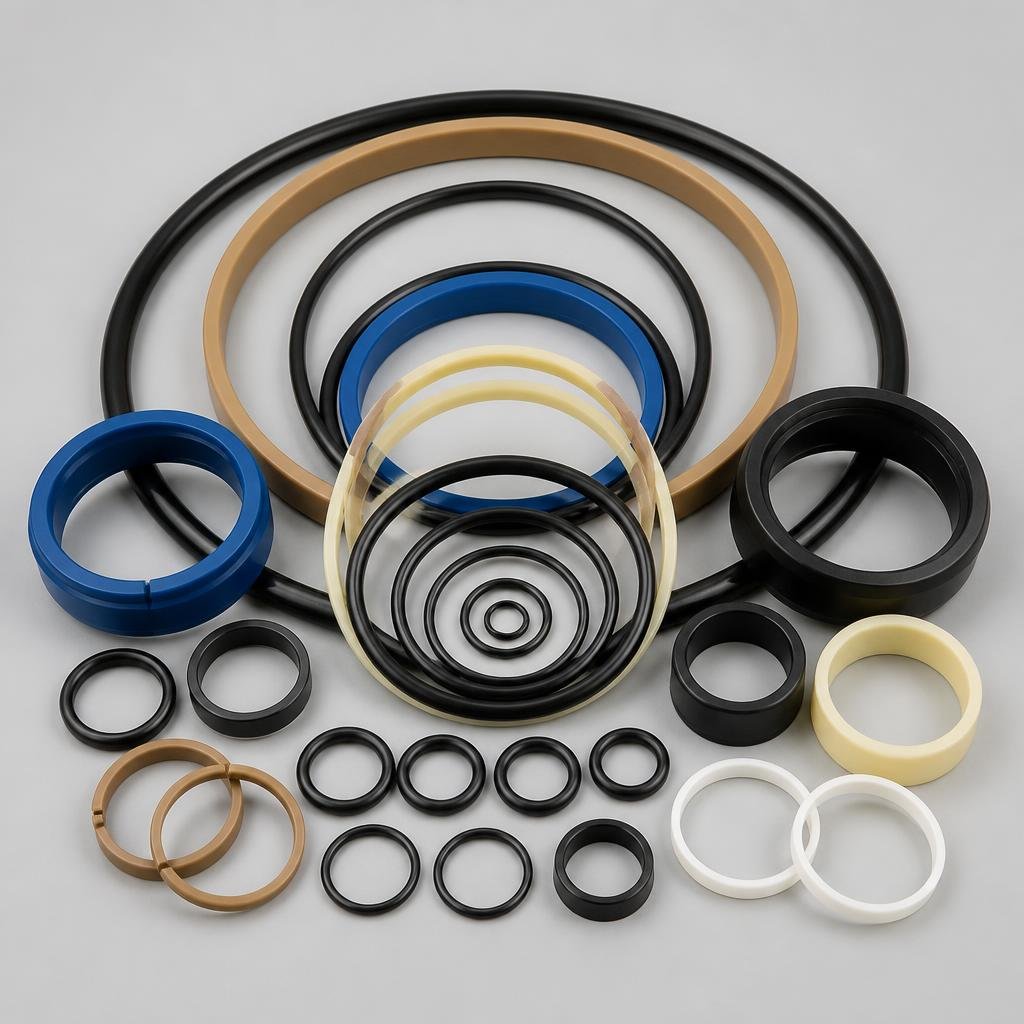
Kits are cut for one cylinder. What's in the packet changes with the model, but you'll find roughly the same pieces in most of them.
| Seal | Its job | When it's gone |
|---|---|---|
| Piston seal | Holds pressure across the piston | Drift, weak or slow cylinder |
| Rod seal | Keeps oil from creeping out along the rod | Oil on the chrome and gland |
| Wiper (dust) seal | Scrapes dirt off the rod on the way in | Mud in the gland, scored rod |
| Buffer seal (not every cylinder) | Takes pressure spikes before they hit the rod seal | Rod seal keeps failing |
| Guide or wear rings | Keep piston and rod centred | Knocking, rod worn on one side |
| O-rings and backup rings | Seal the fixed joints at gland and piston | Weeping at the gland joint |
Our advice? Change the whole kit. The seal you can see leaking isn't the only tired one in there. Stripping the same cylinder twice will cost you more than the kit did.
Kits We Supply by Cylinder and Machine
We keep kits for the main working cylinders on excavators and backhoe loaders. Sizes shift between models, sometimes between years of the same model. Nothing leaves the counter until it's matched.
| Cylinder | Machines | Note |
|---|---|---|
| Boom | Excavators and backhoe loaders, all six brands | Often the first to drift |
| Arm (dipper) | Excavators and backhoe loaders | Slow arm under load points here |
| Bucket | Excavators and backhoe loaders | Takes a beating in rock and quarry work |
| Loader lift and shovel | Backhoe loaders | Front end |
| Stabiliser | Backhoe loaders | Sinking leg while digging |
| Brake | Backhoe loaders | Separate, much smaller kit |
On a JCB backhoe, tell us which cylinder you mean. A JCB seal kit for the dipper won't go in the loader arm, even if the two cylinders look alike from where you're standing.
Tracked machines are no different. We match an excavator seal kit to the model and to where that cylinder sits on the machine. The rest of what we stock is listed on the K.G. Diesel Spares & Services homepage.
Why New Seals Sometimes Fail Early
Fresh kit, leaking again in three weeks. It happens. And the kit is hardly ever the culprit.Look at the rod. A machine that stood out through the monsoon picks up rust spots on the chrome. One stone flying off the bucket can leave a dent. Run a thumbnail along the rod, and if it catches anywhere, new seals won't last. Get the rod repaired or replaced before you reseal.
Then there's the fitting itself. Push a seal over sharp threads or a port edge and it's nicked before the gland is even back on. Dust on the bench ends up inside the cylinder.
And a kit that's a size out will leak however carefully it goes in. That part we can help with. It's why we match kits by part number or measurement, never by eye.
Getting the Right Kit on the First Order
A millimetre is enough. Two kits can look identical in the packet and still be a millimetre apart on the rod seal, and that millimetre is your leak. With the machine up in the hills, a wrong kit costs you days, not hours.
When you WhatsApp us, send:
- Make, model and year of the machine.
- Which cylinder (boom, arm, bucket, loader or stabiliser).
- Part number off the cylinder tube or from the parts book.
- No part number? Rod diameter and bore size.
- Photos of the cylinder and the gland end.
Price and stock usually come back the same day. What it costs depends on the cylinder and on genuine versus equivalent, so we quote after matching.
Supply Across Punjab, Himachal and Beyond
The counter's at SCF-279, Mansa Devi Road, near SBI Bank, Motor Market, Manimajra. Walk in and pick it up. Driving in from another town? Ring first and we'll have the kit matched and set aside.
Further out, we do same-day and next-day supply to Punjab, Haryana, Himachal Pradesh, Rajasthan and Uttarakhand. Outside those five? Still fine. People in 23 states buy from us. Just check the timing for your area when you order.
Genuine or Equivalent: What You Get
We stock both. Plenty of owners with a newer machine want genuine, full stop. Equivalent kits fit the same cylinder for less money, and a lot of older machines with heavy hours on the meter run happily on them.
Your call. The quote tells you which one you're getting before you pay.
Seal Kit Questions From the Workshop
All the seals one cylinder needs, in one packet. Piston seal, rod seal, wiper, guide rings, O-rings and backup rings. It's made for a particular cylinder, so it has to match yours.