How the Drive Sprocket Works in the Undercarriage
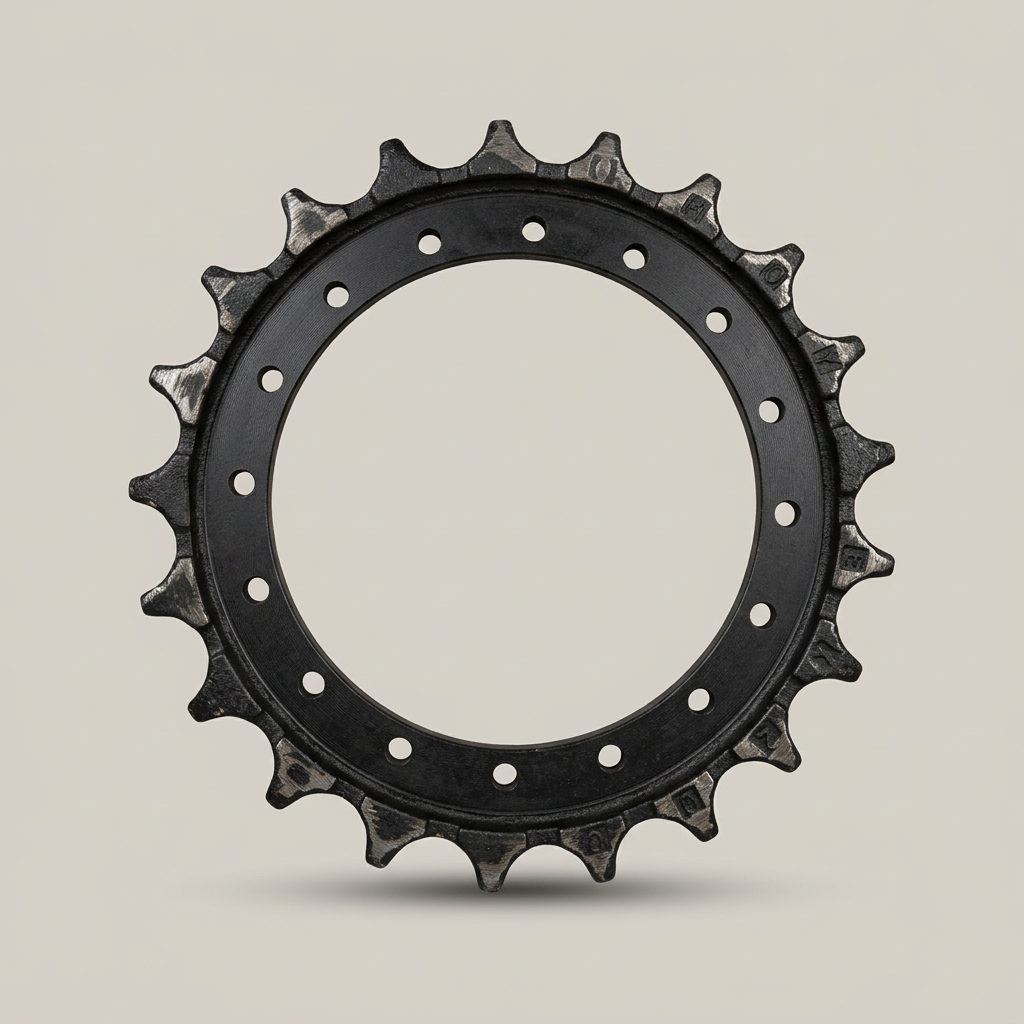
The undercarriage of a tracked excavator is a system of parts that wear together. The driving motor powers the sprocket, whose teeth engage the track chain’s bushings to move the track chain around the front idler wheel and track rollers mounted underneath.
Due to the fact that the sprocket and track chain mesh together, the condition of the former impacts the latter, as the worn sprocket will not guide the chain bushings effectively, and the extended chain with worn bushings will ride the sprocket teeth. This is why sprockets, chains, rollers and idlers are best thought of as one system.
Undercarriage parts make up a large share of the running cost of a tracked excavator. Looking after the sprocket and replacing it at the right time protects the rest of that investment.
Which Machines Utilize Sprocket for Excavator?
Both wheeled and tracked JCB machinery are available; therefore, it would help if you knew whether your machine requires a sprocket. For example, a wheeled machine like the JCB 3DX backhoe loader uses tyres to drive and lacks a drive sprocket.
A sprocket is used only on machines that run on a track chain. In the JCB range, this means JCB tracked excavators such as the JS140 and JS205. Whenever this page refers to a JCB sprocket, it means the sprocket for one of these JCB excavators.
Each excavator model uses a sprocket designed for its final drive and track chain. The details that need to match include:
- The number of teeth on the sprocket
- The pitch, which must match the track chain
- The bolt hole pattern and the diameter of the mounting
- The thickness and profile of the teeth
- One Piece Ring vs. Segmented sprocket type
Even excavators of the same weights from competing brands have different types of sprocket, and the same with JCB excavators.
The best way to get your sprocket is to inform us on the brand, excavator model such as JCB JS205, as well as a photo of an existing sprocket you would like to replace. We stock a wide range of sprocket assemblies for JCB excavators and Hyundai, Tata, Hitachi, Komatsu, Volvo and CAT excavators.
When It’s Time to Replace your Sprocket for Excavator
Sprocket wear can be tricky and not immediately noticeable. Here are some symptoms that indicate that your sprocket needs replacing.
- Hooked or pointed teeth. New sprocket teeth have a rounded profile. As they wear, they become sharp and hooked, sometimes described as a shark fin shape.
- Track slipping or jumping. When the teeth can no longer hold the chain bushings firmly, the track may jump teeth under load, especially when reversing or climbing.
- Uneven wear on the teeth. The wear of the teeth on one side is an indication of track misalignment or malfunctioning of the idler or rollers.
- Noise coming from the undercarriage. A grinding or clunking noise as the track turns can come from a worn sprocket meshing poorly with the chain.
- Cracked or broken teeth. Rocks or debris can crack teeth, and a broken tooth puts extra load on the next teeth.
Why the Sprocket and Track Chain Should Be Matched
One of the most common and costly mistakes in undercarriage repair is fitting a new sprocket to a badly worn chain, or a new chain to a worn sprocket.
A worn track chain stretches as its pins and bushings wear. Its effective pitch becomes longer than the pitch of a new sprocket. When the two are fitted together, the chain rides high on the teeth and wears the new sprocket very quickly. The same happens in reverse when a new chain runs on a worn sprocket.
For the longest life, the sprocket should be replaced together with the track chain, or at least when the chain is turned or rebuilt. We provide track chain and shoes, track rollers and idlers, and sprockets so that you may be able to design your entire undercarriage.
How to Extend Your Sprocket Life?
Life span of the undercarriage largely depends on the operation and maintenance of machinery. Minor improvements in the working habit will contribute thousands of hours to the life span of sprockets.
- Keep track tension correct. A track that is too tight increases wear on the sprocket and bushings. One that is too loose can cause the teeth to jump. Check the tension and make adjustments to it according to the ground conditions.
- Undercarriage cleaning. The packed mud, clay, and stones cause increased tension and wear on the teeth of the sprocket wheel. Undercarriage cleaning should be done at the end of the shift.
- Limit high-speed travel and reversing. Long distances at high speed and frequent reversing wear the sprocket and bushings faster.
- Avoid constant turning in one direction. Alternating turns spreads wear evenly across both tracks.
- Work across slopes carefully. Constant working on slopes puts side loads on the sprocket and the rest of the undercarriage.
- Check the bolts. Loose sprocket bolts allow movement that damages both the sprocket and the final drive hub.
Fitting a New Sprocket
The replacement of the sprocket is done by either taking out the track or detaching it from the sprocket, unbolting the old sprocket from the final drive hub and replacing it with the new one. It is necessary to clean the mounting face before mounting the new sprocket.
The bolts should be tightened in a cross pattern to the correct torque. This is also a good time to inspect the final drive for oil leaks and to check the condition of the track rollers, the idler and the track chain.
If the machine has been slow or weak when travelling, the problem may not be in the undercarriage. Travel and final drive motors depend on a healthy hydraulic system, and our JCB hydraulic pump parts page explains common pump issues. A leaking travel line may need a new hydraulic hose.
How Ground Conditions Affect Sprocket Wear
The life span of the sprocket largely depends on the nature of the surface on which the excavator is working, as two similar excavators can use up their sprockets in completely different periods of time just because of the place where they are operating.
Sand and fine-grained abrasive soil create something like an abrasive paste in between the sprocket teeth and the chain bushings, resulting in faster wear. Rocky ground and quarry work cause impact damage, chipping and cracking of the teeth.
The wet clay and mud become compacted in the undercarriage, which increases the tension in the track and the pressure on the sprocket; under such conditions it is helpful to clean the tracks regularly and to slightly loosen the tension (but within the recommended range) in order to reduce wear.
If your machine works mostly in one type of ground, let us know when you order. It helps us suggest the right parts and a sensible inspection routine for your undercarriage.
What to Share When Ordering a Sprocket
We shall get the right sprocket for your machine faster if you provide as many of the following details as possible:
- Brand and make of the machine. For instance, JCB JS140 or JS205.
- A picture of the existing sprocket, highlighting the teeth and bolt holes.
- The number of teeth and the number of bolt holes.
- Any part number cast or stamped on the sprocket.
- Do you require the track chain, rollers, or idlers?
With all these specifications, we can verify the accurate part, price, and delivery time, typically the same day.
Why Choose K.G. Diesel for Undercarriage Parts
Our counter in the Motor Market, Manimajra, has supplied earthmoving parts for more than 30 years. Contractors and fleet owners return for a few simple reasons.
We keep over 1500 parts in stock, including undercarriage parts such as sprockets, track rollers, idlers and track chain and shoe assemblies. We supply genuine and OEM-equivalent parts, and we check each one before it leaves the counter.
We cover JCB, Hyundai, Tata Hitachi, Komatsu, Volvo and CAT machines from one place, which is useful for owners running mixed fleets. We offer same-day and next-day dispatch across Punjab, Haryana, Himachal Pradesh, Rajasthan, and Uttarakhand, and we can source parts we don't have in stock.
Along with undercarriage work, many of our customers also order JCB pin bush kits and excavator bucket teeth when their machines are in for service.
Frequently Asked Questions
The sprocket is bolted to the final drive and engages the track chain. It distributes the power coming from the final drive in order to move the unit either forwards or backwards.