Idler for Excavator, Not Conveyor Idler
The term idler is applied in various industries, and it may happen to be difficult to locate the desired item while browsing through online sources. Idler is referred to as a small roller in a belt conveyor. These are completely different parts from the idler on an excavator.
This page is about the front idler used in the undercarriage of tracked excavators and similar machines. If you are looking for parts for an earthmoving machine, you are in the right place.
The Location and Function of the Idler
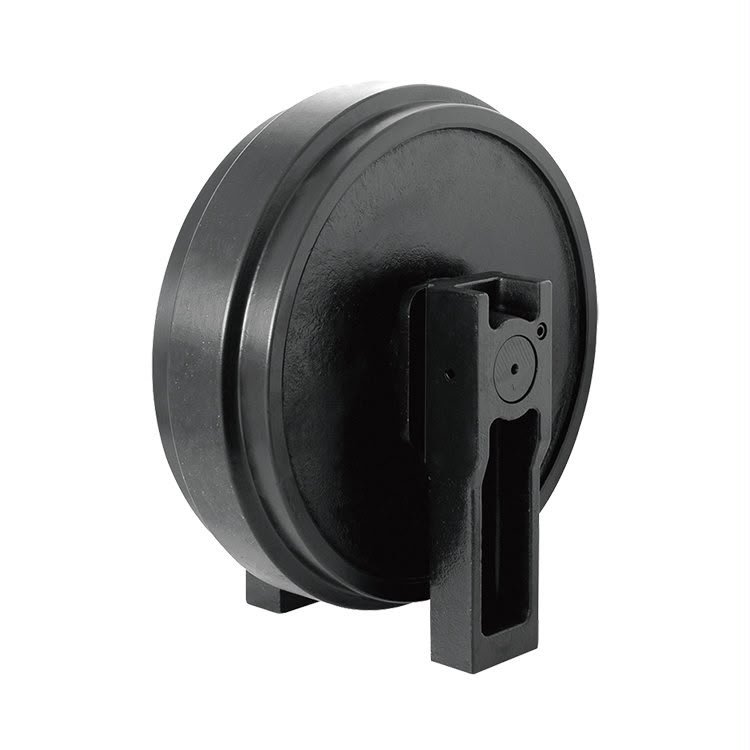
For the tracked excavator, the sprocket found at the rear drives the track whereas the idler found at the front maintains motion and rotation of the track. The track links loop around the idler, meaning that all the links run over it.
The idler is not fixed rigidly in place. It is mounted on a yoke that can slide forwards and backwards, and it is connected to the track adjuster and recoil spring behind it.
The Track Adjuster
The track adjuster is a cylinder filled with grease. Adding grease pushes the idler forward and tightens the track. Releasing grease lets the idler move back and loosens the track. This is how track tension is set on most excavators.
The Recoil Spring
The recoil spring is positioned behind the adjuster. In case of hitting an obstacle or getting a stone caught between the chain and the idler, the recoil spring allows for a backward movement of the idler and returns it to its place. This prevents the undercarriage from shock loading.
Since the idler, adjuster, and recoil spring operate as one unit, their malfunction will cause problems with the track. That is why we look at the whole picture when a customer reports idler wear.
Idler Wear: Signs to Be Aware Of
Idlers are supposed to be durable, but idler wear is still possible, and it can be spotted during an inspection.
Worn Running Surface
The idler has running surfaces on either side of a centre flange. The track chain links run on these surfaces. As they wear, the idler loses diameter and the chain sits lower, which changes how the whole track runs.
Worn or Sharp Centre Flange
The centre flange keeps the chain aligned. In case of thinning of the flange or sharp edges on the flange, there will be side movement of the chain and in extreme cases, the track may fall off. The presence of the knife edge flange means that the idler should be changed.
Oil Leakage
Like track rollers, idlers are filled with oil and sealed at each side. Oil on the idler or on the shaft means that the seal has failed. The lack of oil causes the bushings to wear fast, leading to wobbling of the idler.
Wobble or Play
If the idler moves from side to side or tilts when the track is moving, the bushings or shaft are worn. Running in this condition puts uneven load on the chain and can damage the yoke and the track frame.
How Track Tension Affects Your Idler
Track tension is the most important idler life determining variable, which is controlled by the operator. Tensioning takes only a few minutes and returns a lot.
Too much track tension causes the idler to press strongly on the chain. It raises the wear rate of the idler, the sprocket and bushings, and increases fuel consumption in travel mode. If the track tension is too loose, then the track will hit the frame and will jump off the idler or the sprocket and cause uneven wearing of the flange.
To measure the track tension, the machinery needs to be parked on an even ground surface, drive some distance forward and stop. Measure the sag of the track between the carrier roller and the idler, or at the point stated in the operator's manual and adjust using the grease cylinder till the sag equals the required value.
In wet and sticky soil, track tension should be a little less than in hard and dry soil, since the packed soil increases track tension.
Ordering the Right Idler: A Simple Checklist
An idler for one tracked excavator model may look similar to another but differ in width, shaft size or mounting. To avoid mistakes, please share the following when you contact us:
- Machine make and exact model.
- Part number from the old idler or the parts manual, if available.
- Whether you need the idler alone or the idler with yoke.
- Photos of the idler, including the side view and the mounting.
- Machine serial number, where the model has had different versions.
- Quantity required, for one side or both.
With these details, we can check fitment before dispatch. This way you avoid time wasted with the arrival of an unmatching part.
Should You Repair or Replace Idler?
Not every problem means a new idler. In the case where the idler is leaking, yet the surfaces and flange are well-preserved, it may imply that the problem may just have to do with the bushings. It implies that in certain situations the repair might be the best choice depending on the condition of the shaft and housing.
When the running surface and the center flange are in bad shape, they should be replaced. A heavily worn idler will keep damaging the chain no matter how good the seals are.
There is always a rule when assessing whether one should look at the price of the item versus the loss in productivity in case of breakdown. In case of machinery that has to run constantly, fitting the idler once may be more economical.
Fitting a New Idler: What to Keep in Mind
Before removing the old idler, you will need to reduce the track tension via the grease valve on the track adjuster. The track adjuster stores the grease at high pressure. Therefore, it is important that the grease valve be turned only as much as necessary.
After mounting the new idler, it is imperative to position it correctly within the track frame such that it can move easily through the guides. Ensure proper tensioning of the track as per the manufacturer's specifications and that the tension does not change even after several hours of operation.
It is also good practice to inspect the recoil spring and adjuster while the track is open. A leaking adjuster cylinder will not hold tension, and the new idler will suffer for it.
Daily Care That Protects the Idler
A few minutes of care each day can add a great deal to idler life. Clean the mud, stones, and debris from the area surrounding the idlers and the track frame once you finish working. During the winter months, the frozen debris will freeze the undercarriage and cause too much strain on the idler and seals for the next shift.
During your walk-around check, you must look at the oil on the idlers, track sag, and any unusual noises. Reporting a small leak early is far cheaper than replacing a seized idler and a damaged chain later.
Idlers, Rollers and the Rest of the Undercarriage
The undercarriage works as a system. The idler, the track chain, the sprocket, the carrier rollers and the excavator track roller all wear together, and the condition of one affects the others.
When you replace an idler, it is a good time to measure the chain and check the rollers as well. Fitting a new idler to a badly stretched chain will not give the life you expect, because the worn chain will start wearing the new idler straight away.
One Source for JCB Spare Parts
KG Earth Movers offers spare parts of JCB as well as parts of other earth moving machinery. You can order undercarriage spare parts and other spares via a single point of contact. It has been seen that many clients ordering undercarriage spare parts require hydraulic spares like hydraulic brake cylinder/seal kit.
You can see our complete range on the K.G. Diesel Spares & Services homepage.
Questions About Idler for Excavator
The front idler controls the track chain on the front of the undercarriage, helps regulate track tension using the track adjuster and cooperates with the recoil spring to absorb shock loads.