First, Find Out Which Pump Your Machine Has
Before anyone can price or supply a part, we need to know what kind of pump is on the machine. Most earthmoving equipment uses either a gear pump or an axial piston pump, and the parts for the two are completely different.
| Feature | Gear Pump | Axial Piston Pump |
|---|---|---|
| Commonly found on | Many backhoe loaders, including popular JCB models | Most tracked excavators across leading brands |
| How it works | Two meshing gears carry oil from the inlet to the outlet | Pistons in a rotating cylinder block draw in and push out oil |
| Flow output | Fixed flow for a given engine speed | Usually variable, adjusting flow to the load |
| Main wear parts | Gears, bushes, wear plates and seals | Piston shoes, cylinder block, valve plate, swash plate and seals |
Some machines also run a tandem pump, which is two pump sections on a single shaft feeding separate circuits. If you are not sure what is fitted to yours, send us the model and a photo of the pump and we will work it out with you.
Hydraulic Pump Parts We Supply
When a pump is opened up for overhaul, the damage is usually found in the same handful of parts. These are the components we are asked for most often.
For Piston Pumps
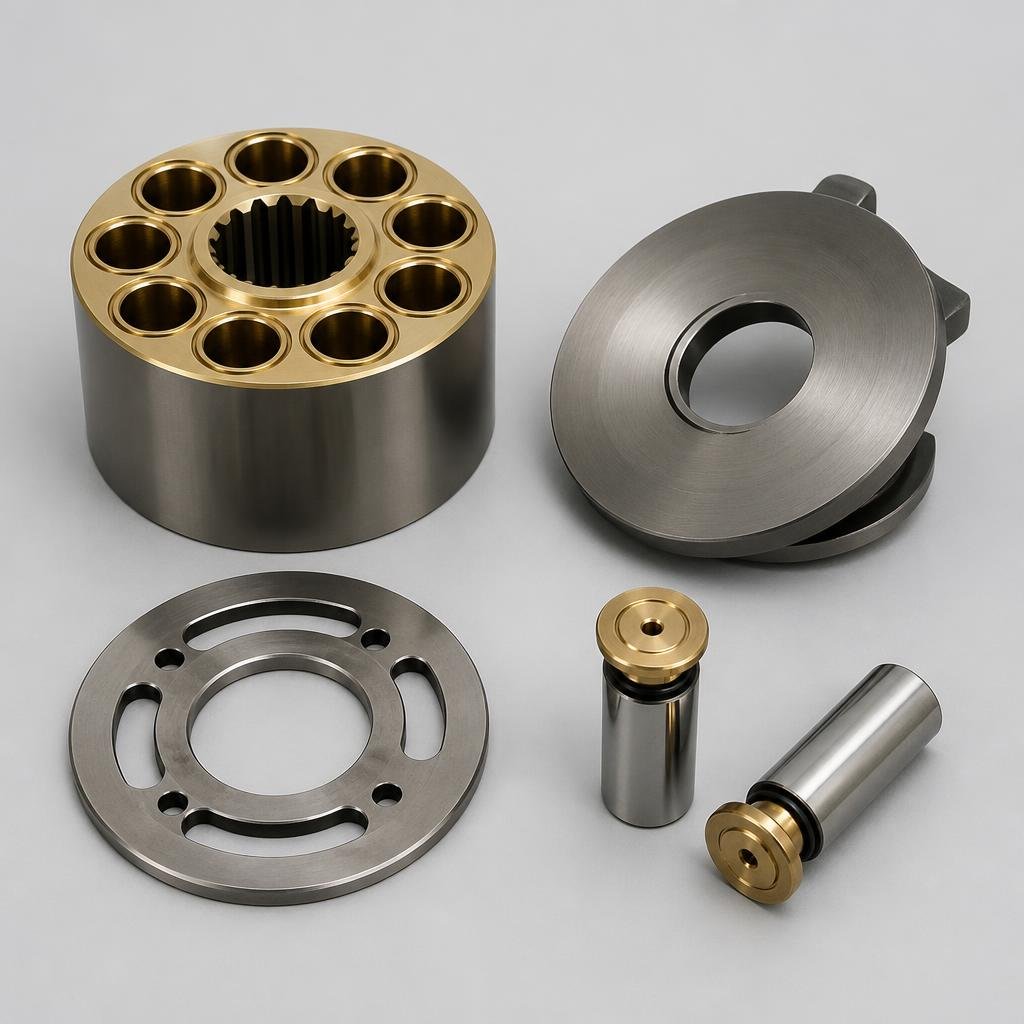
The piston and shoe assemblies take the most punishment. The pistons slide in and out of the cylinder block, and the shoes on their ends ride against the swash plate the whole time the pump is running. Old shoes are probably one of the most common causes for a piston pump’s inefficiency.
The Cylinder Block contains the pistons and revolves with the shaft. If its faces or bores are worn, oil will escape through and decrease efficiency. The valve plate sits against the block and controls oil going in and out, so wear on its face causes the same kind of internal leakage.
We also supply swash plates, retainer plates and ball guides, which hold the shoes in place and set the pump's displacement. Most rebuilds also need new shafts, bearings or a seal kit.
For Gear Pumps
Gear pumps are simpler, but they wear in their own way. Wearing of gear teeth and the sides of gears occurs with time resulting in decreased flow and pressure. The bushes and wear plates maintain the narrow clearances in the pump and once the clearances are increased, oil flows back rather than flowing out. Shaft seals and body seals prevent oil from leaking out and allow air to enter.
We keep a good range of these JCB hydraulic parts in stock and can source parts for other brands when they are needed.
Signs the Pump Is on Its Way Out
Pumps rarely stop working overnight. However, there are always warnings, and an early diagnosis may lead to replacement of only some components, not the entire pump.
The first thing that operators complain about is poor performance. The boom, arm, or bucket moves slower than it is supposed to, and the problem becomes worse when the oil gets hot. This condition usually means that the oil has leaked from the pump through worn-out components.
Another sign of a faulty hydraulic pump is the loss of power. A whining or knocking sound from the pump is another warning. It can mean worn internal parts, or cavitation, where the pump is not getting enough oil because of air in the system or a restricted inlet.
Other signs to look out for:
- Hydraulic oil is running hotter than normal.
- Shiny metal particles in the return filter or the oil.
- Oil leaking past the shaft or body of the pump generally indicates a problem with the seal.
A word of warning. A slow machine does not always have a bad pump. This may be due to leakage from hoses, worn piston rings, filter clogging, or relief valve failure; thus, the importance of conducting a complete check before pumping.
Why Pumps Wear Out Early
In our experience, a pump usually fails because of what is happening in the rest of the hydraulic system, not because the pump itself was faulty.
Dirty oil does the most damage. Dust, water, and metallic particles wear out the well-polished surfaces of the pump. These impurities enter due to delayed replacement of filters, due to poor installation of hydraulic hose pipes, and due to refilling from contaminated sources.
Low oil levels and a blocked suction line starve the pump and cause cavitation. Overheating thins the oil so it no longer protects the moving parts properly, and the wrong grade of oil causes the same problem.
If these causes are not dealt with during an overhaul, the new parts will wear out just as fast as the old ones did. After a pump failure, the system should also be flushed and the filters changed, because debris from the old pump stays in the lines, valves and tank and will go straight into the new parts.
Should You Repair the Pump or Replace It?
This is a question we get almost every time a pump comes up. In many cases a repair makes more sense. If the pump body is in good shape and the wear is limited to the rotating group, shoes, plates and seals, new internal parts can bring the pump back to good working order for much less than the cost of a new unit.
A replacement is usually the better choice when the housing is cracked, when heavy contamination has damaged the pump badly, or when several major parts are worn out at the same time. Once the pump has been opened and checked, we can help you decide which way to go.
What Decides the Hydraulic Pump Parts Price
Many customers call us for a hydraulic pump parts price before the problem has been diagnosed. We understand why, but the honest answer is that it depends on a few things.
The first is the machine and the type of pump. Gear pumps and piston pumps are priced very differently, and bigger machines use bigger pumps that cost more.
The second is whether you need complete hydraulic pump parts or only the parts that have worn. Replacing parts usually costs a lot less.
Third, it is the selection between genuine and OEM parts. Both types of parts are available at our store, but the selection is based on your budget and intended use of the machine.
The last is how far the damage has gone. A pump that is caught early may only need seals and a few internal parts, while one that has been run until it fails can need many components.
The quickest way to get a figure is to call or WhatsApp us with the machine model and a short description of the problem. We shall be back with the latest prices and stock levels.
Maintaining the Hydraulic System
The pump will last just as long as the surrounding oil remains clean. The majority of the things that are necessary for ensuring the good health of your hydraulic system are merely matters of routine.
Make sure you replace the hydraulic fluid and filters as often as prescribed by the equipment maker, particularly when there is much dust around. You should always ensure that you use a clean funnel.
You need to check your oil levels daily as well as the temperature gauge. Correct the detected leaks immediately, since wherever the oil escapes, there enters the dirt.
In cold conditions let the machinery warm up before using it in full force. Cold oil is highly viscous and it might prevent pumping for the first minutes.
In excavators, hydraulic power also provides motion to the tracks via travel motor and the final drive. If the undercarriage needs attention, our excavator drive sprocket page explains what to check. Worn JCB pin bush kits and blunt bucket teeth also make the hydraulic system work harder than it needs to.
What to Send Us When Ordering Pump Parts
Pump parts are made to close tolerances, and a part that is nearly right will not do the job. The more we know, the quicker we can confirm the correct part.
- Machine brand, model and serial number.
- Pump make and model, usually on the plate fixed to the pump body.
- Clear photos of the pump and any damaged parts.
- A short note on the problem, such as slowness, noise or overheating.
- Whether it is a spare part that you require or a seal kit or even a whole pump.
With these specifications, it becomes easy for us to identify the correct JCB hydraulic parts and their price and availability on the very same day. If you happen to be living in Chandigarh, Panchkula or Mohali, then bringing your equipment to us through the old section will surely be the fastest route to take.
FAQs
It depends upon the type of machine and hydraulic pump you need, in addition to whether you require the complete unit or only those parts of the pump that are defective. Do feel free to share the details of your machine with us, and we shall be happy to quote you our most recent rates.